
What Is a Hydraulic Ram Pump?
A hydraulic ram pump, commonly called a ram pump, is a self-acting water pumping machine that uses the energy of flowing water to lift a portion of that water to a higher elevation. It operates automatically without an electric motor or fuel-powered engine.
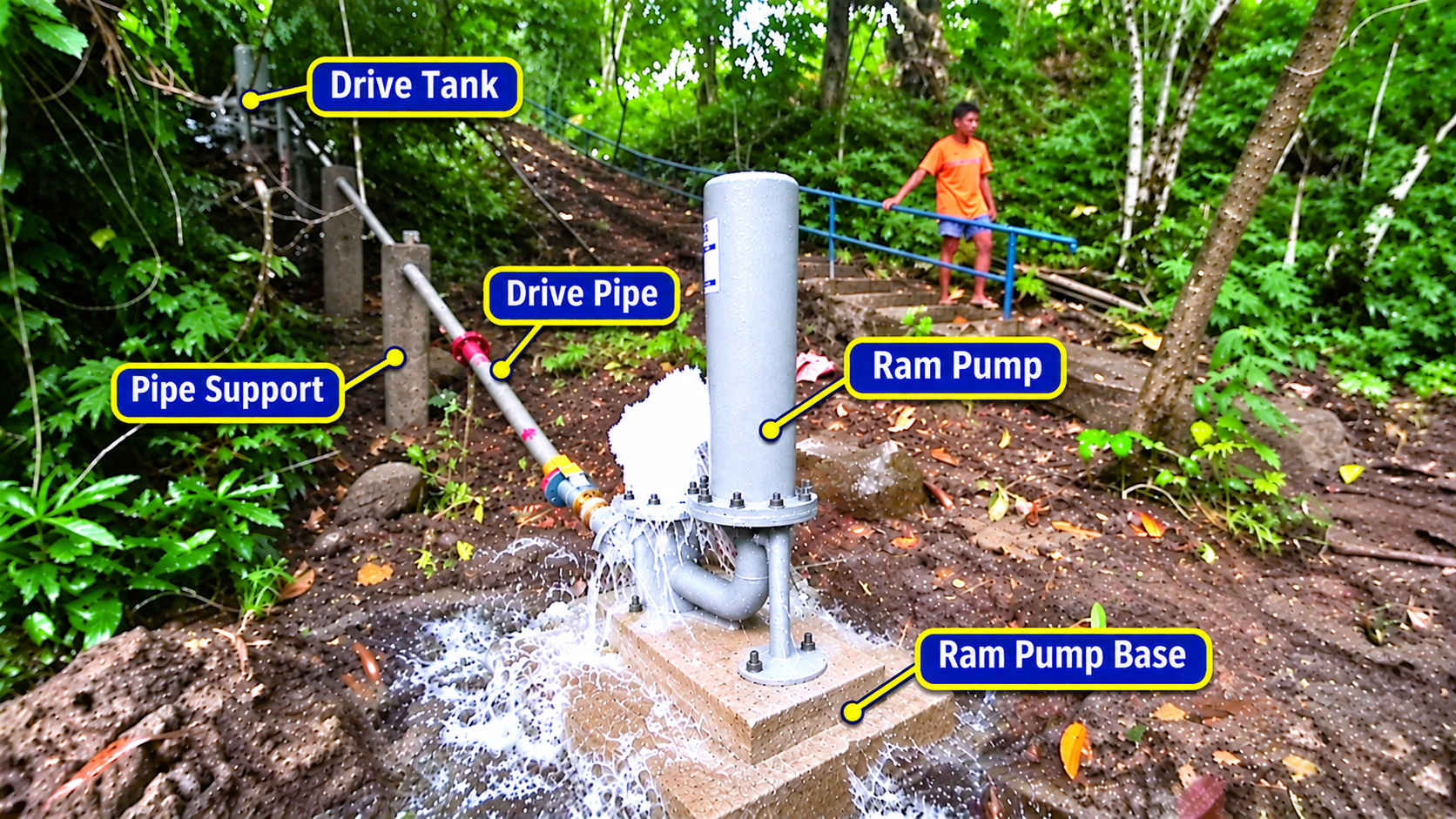
How Is a Ram Pump Constructed?
A hydraulic ram pump has two main sections: the Drive Section and the Delivery Section.
The Drive Section is where water enters the pump from a drive tank through a drive pipe. The water flows into the impulse valve housing, where the sudden closing of the impulse valve creates a pressure surge known as water hammer.
The Delivery Section receives a portion of this pressurized water through a one-way valve called the delivery check valve. The water enters the air chamber, where compressed air helps maintain pressure and pushes water into the delivery pipeline toward a higher elevation.
This process repeats automatically as long as sufficient flowing water and a suitable drive head are available.
Who Invented the Hydraulic Ram Pump?
In 1772, English inventor John Whitehurst developed an early manually operated water-lifting device using the water hammer principle.
In 1796, French inventor Joseph Michel Montgolfier developed the automatic hydraulic ram pump, introducing a self-acting valve mechanism.

Joseph Michel Montgolfier was also one of the famous Montgolfier brothers who pioneered hot-air balloon flight in 1783.
More than two centuries later, hydraulic ram pumps continue to supply water to farms, hillside homes, and remote communities worldwide.
Comments
Share your questions, observations, or experiences with hydraulic ram pumps.